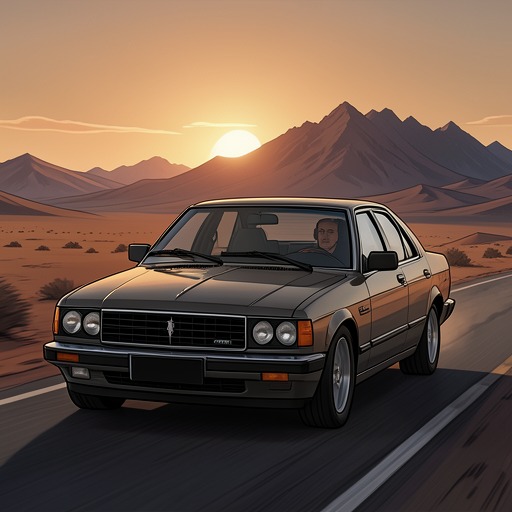
1937 Ford sedan
On the RoadThe 1937 Ford sedan is the battered vehicle that takes Sal Paradise, Dean Moriarty, and Stan Shephard south from Denver in May, carrying them across Texas and over the border into Mexico. Its unhinged door, broken seat, and rough ride make it no polished emblem of freedom: it is an unreliable, cramped machine whose movement nevertheless gives physical form to the travelers’ dream of leaving familiar life behind and reaching an unknown world.
The car and the journey
The Ford is a 1937 sedan that Dean prepares at a nearby station before the group departs Denver. Its right-side door has come unhinged and is tied to the frame; the front passenger seat is broken, leaving whoever sits there leaning back toward the torn roof. Dean jokes that they will go coughing and bouncing all the way to Mexico. The defects are not incidental decoration. They establish the trip’s material terms: the travelers are setting out in a compromised car, not a dependable touring machine, and their ambitious route depends on making it work.
The map sets the scale of the undertaking. The party faces more than a thousand miles, most of them through Texas, to Laredo, followed by another 767 miles across Mexico toward Mexico City. Dean’s conviction that the journey will bring them to “IT” gives the southbound drive a purpose beyond simply covering distance. For Sal, the route marks a break with the familiar east-west pattern of earlier road trips: this time the car points south, toward what he imagines as another world.
A fragile vehicle on dangerous roads
The Ford’s damage remains part of the journey rather than being repaired away. Stan rides with an arm draped over the broken door when a stinging insect embeds itself in his arm outside Denver. The sting rapidly swells and hurts; because the travelers do not know what caused it, they fear the trip may be in trouble before it has properly begun. They continue toward Colorado Springs, planning to stop at a hospital for a penicillin shot. The car’s open, makeshift side and its passengers’ exposure to the passing landscape bring the danger of the road close to the body.
The vehicle carries the group through long stretches of travel and changing conditions. After the party reaches Laredo in the early morning, exhausted and sweating in the oppressive heat, it crosses the bridge into Mexico and turns away from the United States. At dawn, the Ford is already out on the desert flats, with yucca and organ-pipe cactus emerging in the light. Sal and Dean are awake to the unfamiliar country; Stan, who has traveled abroad before, sleeps in the back seat. The contrast makes the car a shared conveyance but not a shared experience: its occupants occupy the same journey with different degrees of anticipation.
The border and the imagined south
At the border, the Ford’s passage gives the journey a visible point of transition. The travelers have arrived in Laredo feeling depleted, and the town seems to them a bleak threshold; once the car crosses the bridge and reaches Mexican soil, the mood changes. They leave the vehicle parked while they walk into the Spanish-speaking streets, buy beer and cigarettes, and take in the night around them. Then they return to the car, glimpse the American side across the Rio Grande, and drive on. The Ford makes the border crossing not just a declaration of intent but a concrete continuation of motion.
Beyond the border the road leads from the desert toward Monterrey. The travelers pass through dry country, then climb a mountain pass among cooler air and clouds before reaching the plateau and the city. Dean refuses to linger in Monterrey because he wants to make time for Mexico City; he drives on while Sal and Stan are exhausted enough to sleep. The Ford thus embodies two competing conditions of the trip: the car keeps the expedition moving according to Dean’s urgency, while its battered construction and the passengers’ fatigue make the cost of that speed tangible.
What the Ford makes possible
The sedan is both practical transport and the fragile platform for an expansive road fantasy. At the start, the broken door, ruined seat, and coughing, bouncing ride insist on the limits of the travelers’ equipment. Yet the same car carries them from a Denver departure to a border crossing and onward into Mexico, where the familiar American road gives way to a landscape they regard as new and immense. Its journey converts an imagined destination into successive, physical passages: across the Texas miles, over the Rio Grande bridge, into the desert at dawn, and through the mountains toward Monterrey.
That tension is central to the Ford’s significance. The southward adventure is spoken of as a leap into another world, but it proceeds by ordinary, vulnerable means: a damaged door tied in place, a passenger seat that cannot hold its rider upright, and a car that must keep going while its occupants grow tired. The vehicle does not guarantee discovery or deliver the travelers from risk. It gives their hope a direction and a means of travel, while its condition continually recalls how precarious that hope is.